Most business owners we talk to are not looking for "a billboard truck". They are looking for more people through the door, more enquiries in the inbox, more tickets sold or more applications for an open role. The truck is just the tool.
This article explains how Digifyads turns that tool into results for Adelaide businesses. We cover what happens behind the scenes of a campaign, the playbooks we use for different industries, the details that separate a good campaign from a forgettable one, and what you can expect from the first phone call to the final GPS report.
The problem we solve
Local businesses in Adelaide face the same squeeze. Online ad costs keep rising, organic social reach keeps falling, and customers have learned to scroll past anything that looks like an ad. Traditional billboards still work, but the best sites are booked by national brands on long contracts, and a single fixed location only reaches people who happen to drive past it.
Digifyads fills that gap. We give local and regional businesses access to large, bright, digital outdoor advertising that:
- goes to where their customers already are, instead of waiting for them
- can be booked by the hour or the day, with no long-term lock-in
- can change message by the time of day, the suburb or the event
- comes with GPS data showing exactly where and when the ad ran
The result is outdoor advertising that behaves more like a targeted campaign than a static sign.
What makes the Digifyads approach different
Routes built around your customer
Every campaign starts with a question: who do you need to reach, and where are they at different times of the day? A café owner in Unley and a construction recruiter in Elizabeth need completely different routes, even if they book the same hours.
We plan routes around four things:
- Where your customers live, work and shop. Suburbs, workplaces, shopping centres and precincts.
- When they are there. Commute peaks, lunch hours, school runs, weekend markets and evening dining.
- Where they are stationary. Traffic lights, queues, car parks, event arrivals and outdoor dining strips, where people have time to read.
- Where you can be acted on. Close to your store, venue or site, so interest turns into a visit.
Three screens, not one
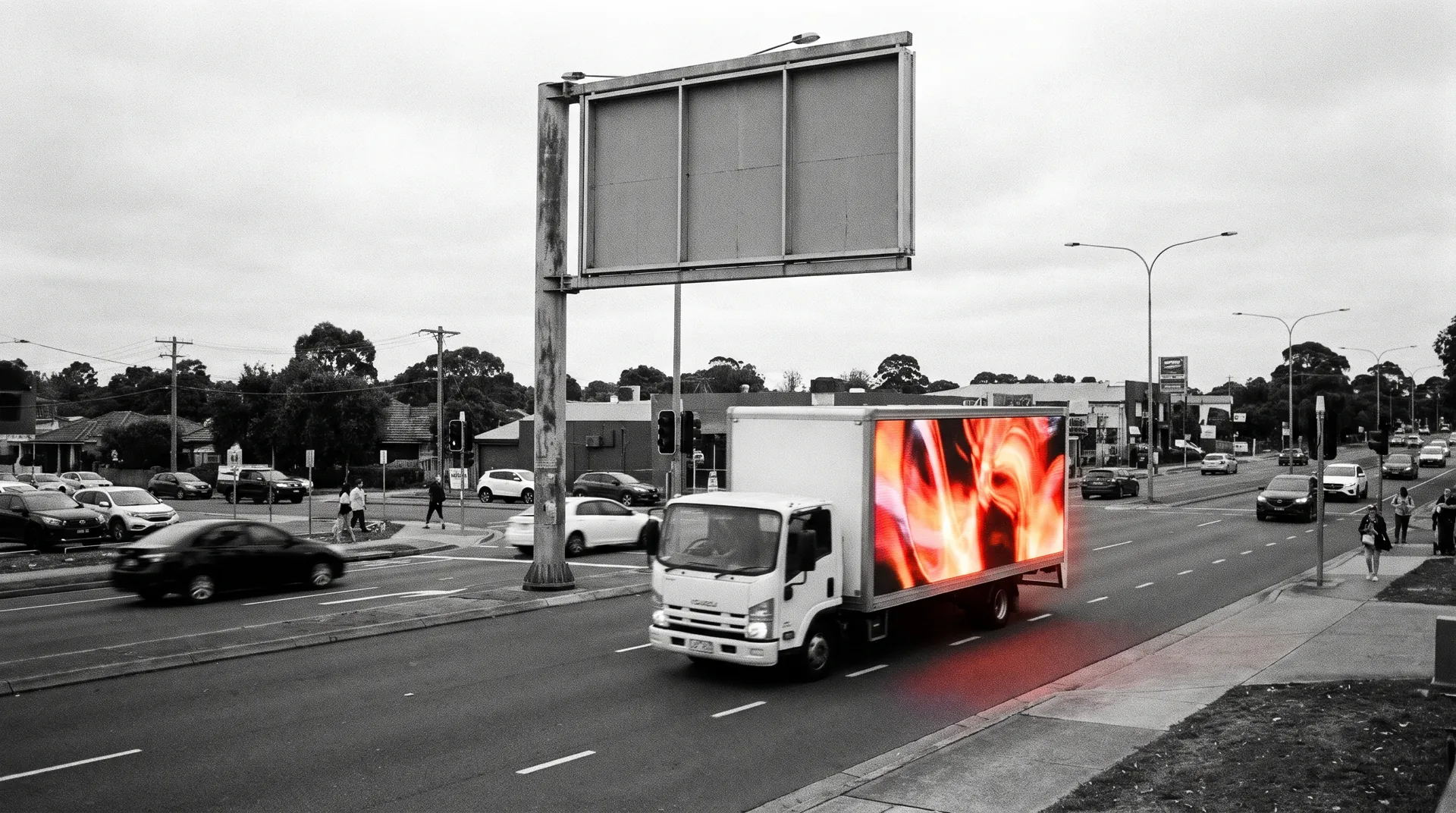
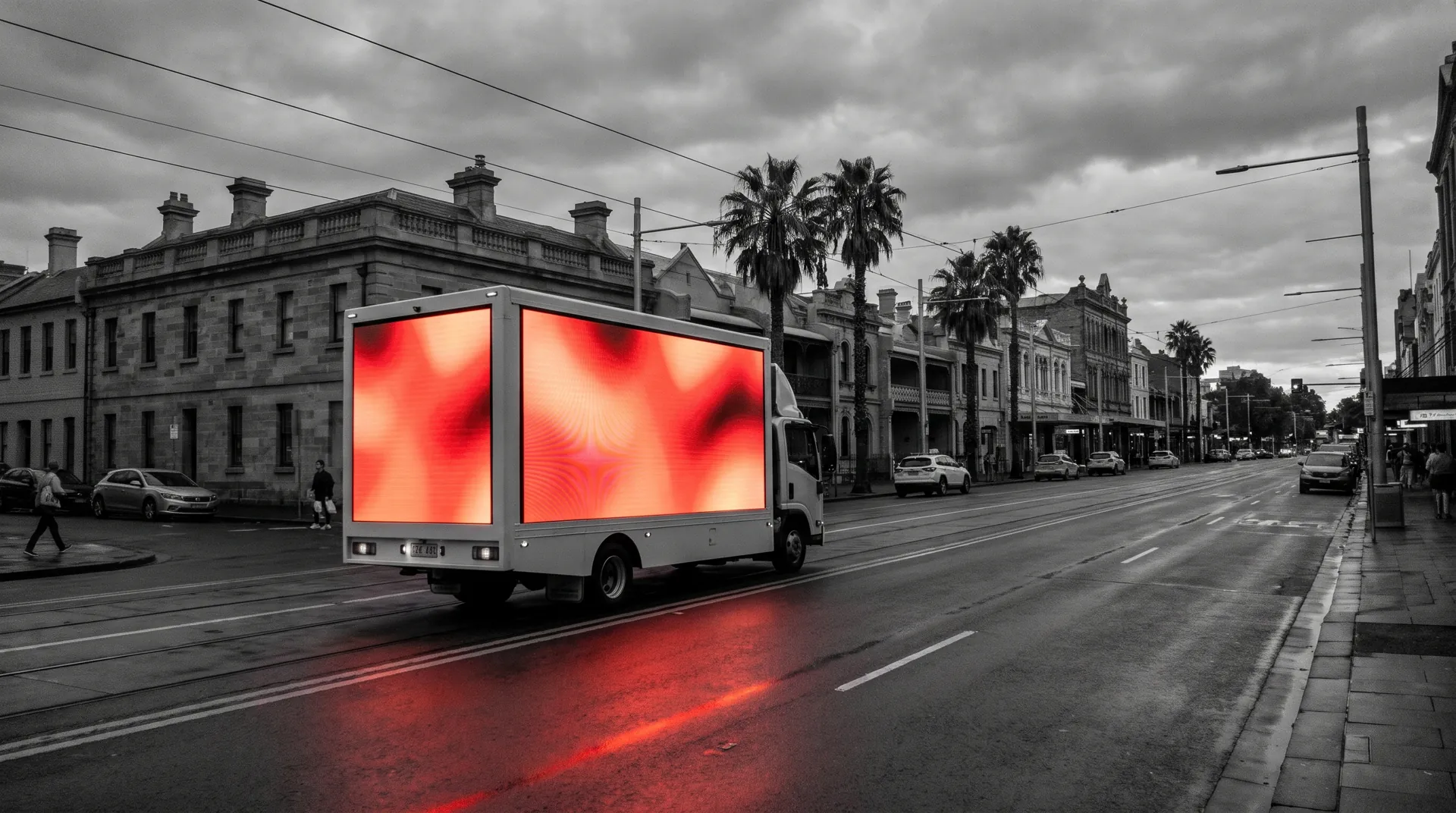
Each truck carries two 3.84m × 1.92m side screens and a 1.92m × 1.76m rear screen. Drivers in the next lane see a side screen. Pedestrians on both footpaths see a side screen. The car behind at the lights sees the rear screen for as long as the light stays red. One truck covers every angle.
Bright enough for an Adelaide summer
Adelaide's midday glare is hard on screens. Our P4 LED panels run at 6,500+ nits with automatic light sensors, so the picture stays crisp in full sun and comfortably bright after dark. They are IP65 weatherproof, so a winter shower does not stop the campaign.
Sound when it counts
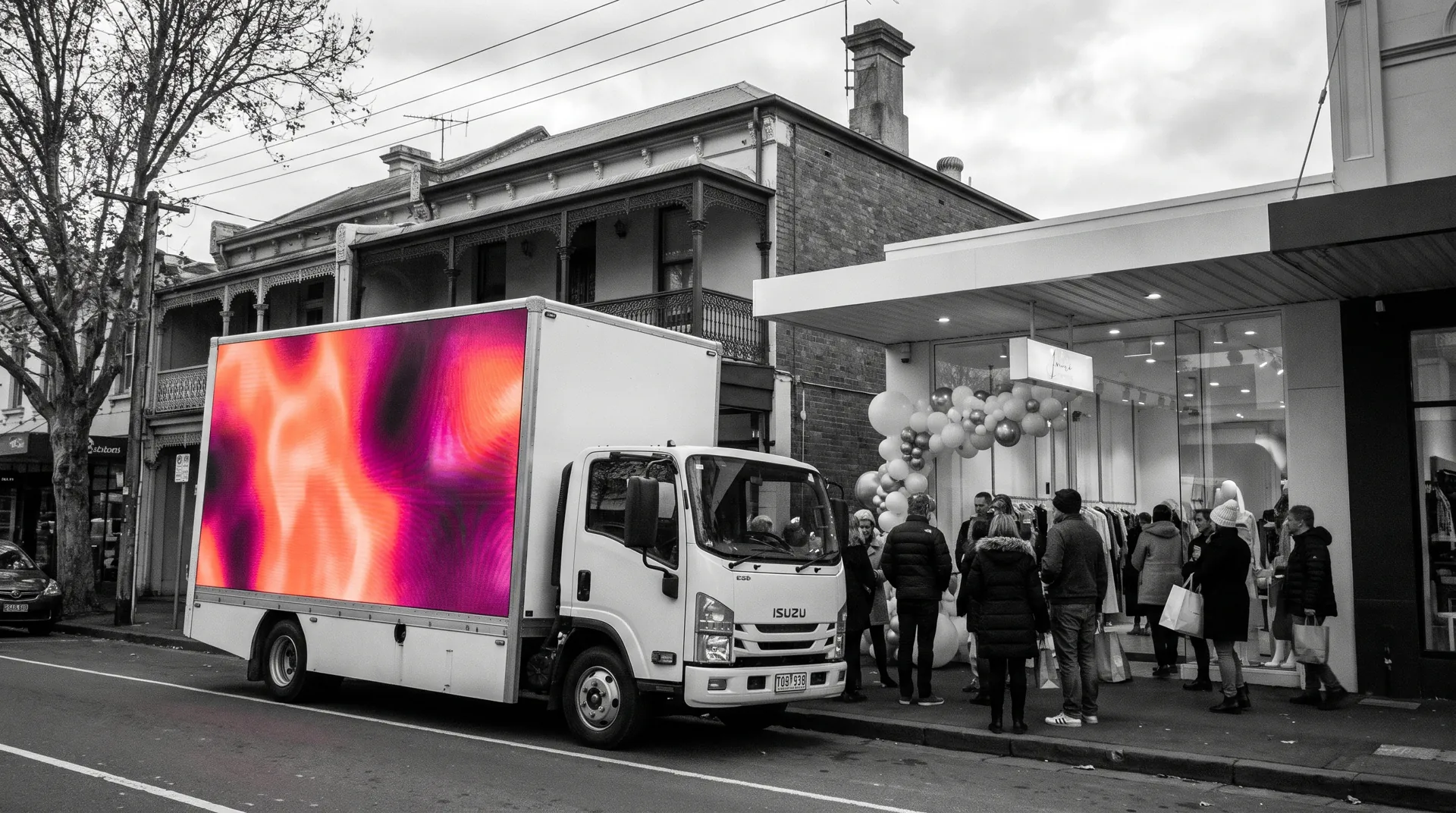
Each truck has a weather-sealed audio system. When the truck is parked at an event, opening or pedestrian zone, sound can be played at compliant volumes to pull people in. A short jingle, a DJ mix or a voice announcement turns a passing glance into a crowd.
Proof of delivery
Every campaign includes live GPS tracking and a route history: where the truck went, how long it stayed in each zone and how fast it was moving. You are not taking our word for it. You can watch it happen.
Real people behind the wheel
Our drivers are professional, presentable and briefed on your campaign. They know when to slow down through a strip, where to park safely near a venue and how to answer the inevitable "who's the truck for?" questions politely and on-message.
Industry playbooks
We do not run the same campaign twice, but patterns do emerge. Here is how we typically approach common types of business. The scenarios below are illustrative examples of how we plan, not reports of specific client results.
Retail: store openings and sales events
The goal: drive foot traffic to a specific location during a specific window.
The playbook: In the days before the event, the truck circles the surrounding suburbs during commute peaks with a simple "Grand opening Saturday" message and the address. On the day, it parks as close as safely possible to the store with audio running, then loops nearby car parks and main roads.
Example: A homewares store opening on The Parade, Norwood books three All-Day Takeovers and receives the fourth day free. Days one to three build awareness across Norwood, Kensington, Burnside and St Peters during commute and school-run hours. Day four, opening day, keeps the truck within a few blocks of the store with a "Today only" offer and a promo code customers mention at checkout.
Hospitality: cafés, restaurants, bars and venues
The goal: fill tables on specific nights and launch new menus.
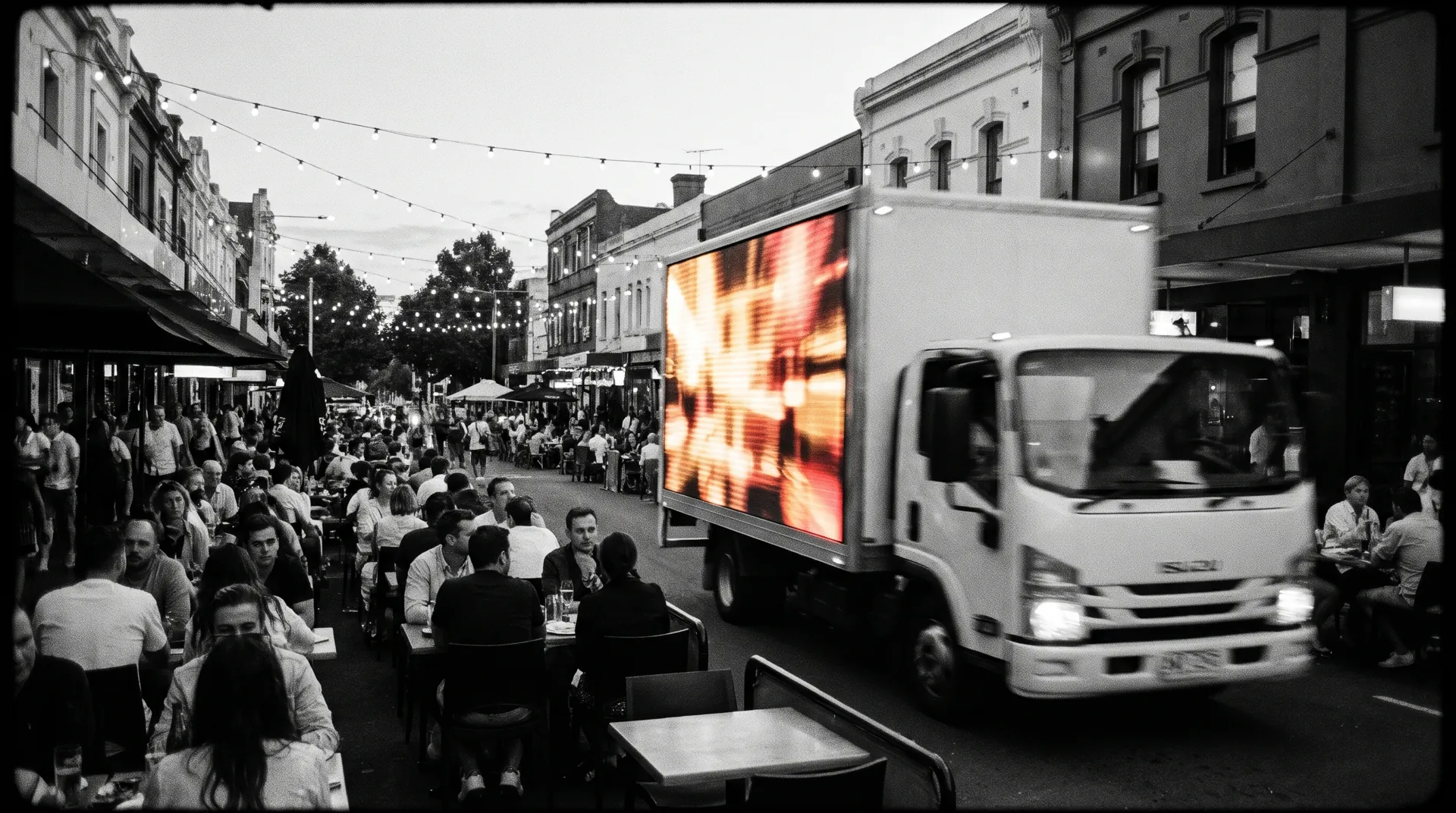
The playbook: Hourly bookings at the right time of day work well here. A three-hour Event Blast from 5pm to 8pm along a dining strip shows the evening offer to people deciding where to eat right now. Day and night creative can be split, so a lunch special plays at noon and a happy-hour offer from 4pm.
Example: A new rooftop bar in the CBD runs Friday evening bookings across a month, parking near office exits at knock-off time and then looping Rundle Street and Hindley Street, with a QR code for table bookings shown while stationary.
Real estate: open homes and developments
The goal: get qualified buyers through an open inspection or interested in a new development.
The playbook: Agents book a few hours on Saturday morning to drive the target suburb and neighbouring suburbs with the property photo, open time and address, then park on the street during the inspection. For off-the-plan projects, longer campaigns target the suburbs where likely buyers currently live.
Example: A developer selling townhouses in a growing northern suburb runs weekly All-Day Takeovers across established suburbs nearby, showing a "From $X" message and directions to the display suite, timed to weekend display hours.
Automotive: dealerships and service centres
The goal: move stock during sales events and stay top of mind with local drivers.
The playbook: The Main North Road corridor through Enfield and the Port Road and Anzac Highway corridors carry exactly the commuters who will one day buy or service a car. Trucks run peak-hour loops past the dealership and competitor yards, with model-specific creative that changes daily.
Events, festivals and entertainment
The goal: sell tickets in the weeks before, and fill the venue on the night.
The playbook: Before the event, the truck runs through the precincts where the target audience spends time (university areas for student events, the east end during Fringe, dining strips for comedy and theatre). On event day, it parks near the venue entrance, the nearest tram stop or the main walking route, with sound running.
Recruitment and employer branding
The goal: attract applicants in a tight labour market.
The playbook: Hiring campaigns work best when they meet workers on their commute. Trucks loop industrial areas, hospitals, trade supply stores and competitor sites at shift changes, with a short "Now hiring" message, the role and a QR code or short URL to apply.
Councils, government and not-for-profits
The goal: reach a broad mix of the community with a public message.
The playbook: Multi-day campaigns rotate through a wide spread of suburbs to reach different demographics. Because screens are digital, we can run several versions of a message, including in community languages, and schedule them by area.
Inside a Digifyads campaign: what actually happens
Clients often ask what goes on between "book" and "go live". Here is the process in detail.
1. Discovery call
We start with a short conversation about your goals. What are you promoting? Who is the customer? What does success look like: bookings, foot traffic, calls, applications, ticket sales? Are there dates you have to hit?
2. Route and schedule plan
We turn that into a route plan with time blocks, key streets, stationary points and a backup route in case of road closures or events. You approve the plan or ask for changes before anything is booked.
3. Creative
You can send finished artwork built to our pixel templates, or our in-house creative team can design it for you. Either way, we review every file for LED readability: text size, contrast, length and how it looks from a moving car. We will tell you honestly if something will not read well on the street.
4. Tracking setup
Before launch we help you set up the simple tools that will show results: a campaign-specific promo code, a short URL with UTM tags, a QR code for stationary moments and a "How did you hear about us?" question for your staff or booking forms.
5. Go live
On the day, the driver collects the truck with your content loaded and starts the route. You receive a live GPS link to follow along, and our coordinator stays on hand for changes. Want to swap the creative at 3pm because a product sold out? We can do that.
6. Report
After the campaign you get the route history and dwell times. Put those next to your sales, web traffic and code redemptions, and you can see what moved.
The details that make the difference
Two campaigns with the same truck and the same hours can produce very different results. These are the details we push on:
Message discipline. A single headline of around seven words outperforms a crowded design every time. If a design needs explaining, it is not finished.
A reason to act now. "This weekend only", "Opening Saturday", "First 50 customers" or "Tickets selling fast" give people a reason to respond instead of just noticing.
Location in the message. Mentioning the suburb or street ("Now open on Jetty Road") turns a generic ad into something that feels local and relevant to the people seeing it.
Repetition. People rarely act the first time they see something. Running the same suburbs over several days builds familiarity, and familiarity builds response.
Pairing with digital. Running Facebook and Instagram ads to the same suburbs during the truck campaign means people see the brand on the street and then again on their phone. Photos and video of the truck in action also make strong social content in their own right.
Picking the right package. Short, high-intensity moments (openings, events, flash sales) suit the hourly Event Blast. Awareness, launches and recruitment usually need the repetition of the All-Day Takeover, and the "book 3, get the 4th free" offer makes a four-day run good value.
What clients usually notice first
Every business measures success differently, but a few things come up again and again after a campaign:
- People mention the truck. Customers, suppliers and even competitors bring it up. The visibility is hard to miss.
- Phones get out. People photograph and film the truck, especially when it is parked with sound running or showing something playful, which spreads the message further on social media.
- Branded searches rise. People who see the truck often search the business name later, so watch your branded search and direct website traffic.
- Staff get a lift. Seeing your brand on a giant screen driving down the main street is good for team morale. It sounds minor, but it comes up often.
Pricing at a glance
- Event Blast: $99 + GST per hour, 3-hour minimum
- All-Day Takeover: $699 + GST per 8-hour day, and book 3 days to get the 4th free
- Custom campaigns: multi-truck, weekly or monthly runs, wraps and road tours on a tailored proposal
All packages include the truck, driver, fuel, all three screens, audio and live GPS reporting. Full details are on the pricing page.
Frequently asked questions
How quickly can we get on the road?
We recommend booking one to two weeks ahead for weekends and major events. Last-minute bookings within 24 to 48 hours are often possible when the calendar allows.
Can we show more than one ad?
Yes. Digital screens let you rotate several ads, split creative between day and night, and change content during the campaign.
Can the truck follow our existing marketing calendar?
Yes. Many clients line the truck up with launches, sales and events they are already promoting online, so each channel supports the others.
Do we need our own designer?
No. Our in-house team designs LED-friendly creative if you need it. If you have a designer, we will send our templates and review the files.
What areas do you cover?
Greater Adelaide, with regular routes through the CBD, Glenelg, Burnside, Unley, Enfield, Henley Beach, Walkerville and many more suburbs. Regional and interstate tours are available on request.
Let's plan your campaign
Whether you need three hours outside a store opening or a month of city-wide awareness, we will build a route around your customers and give you the data to judge the result. Request a free quote, call 0455 665 257 or email info@digifyads.com.au.