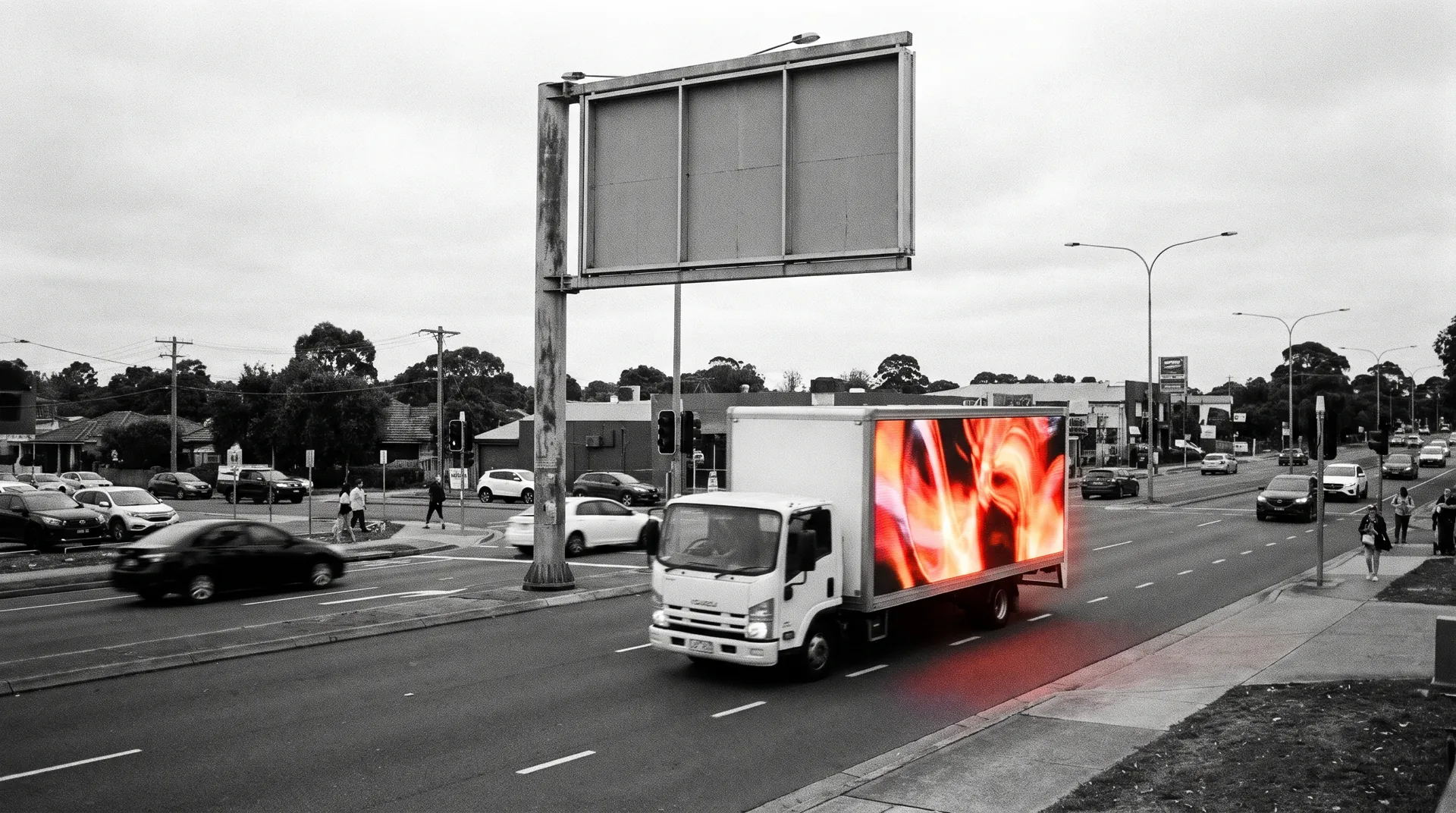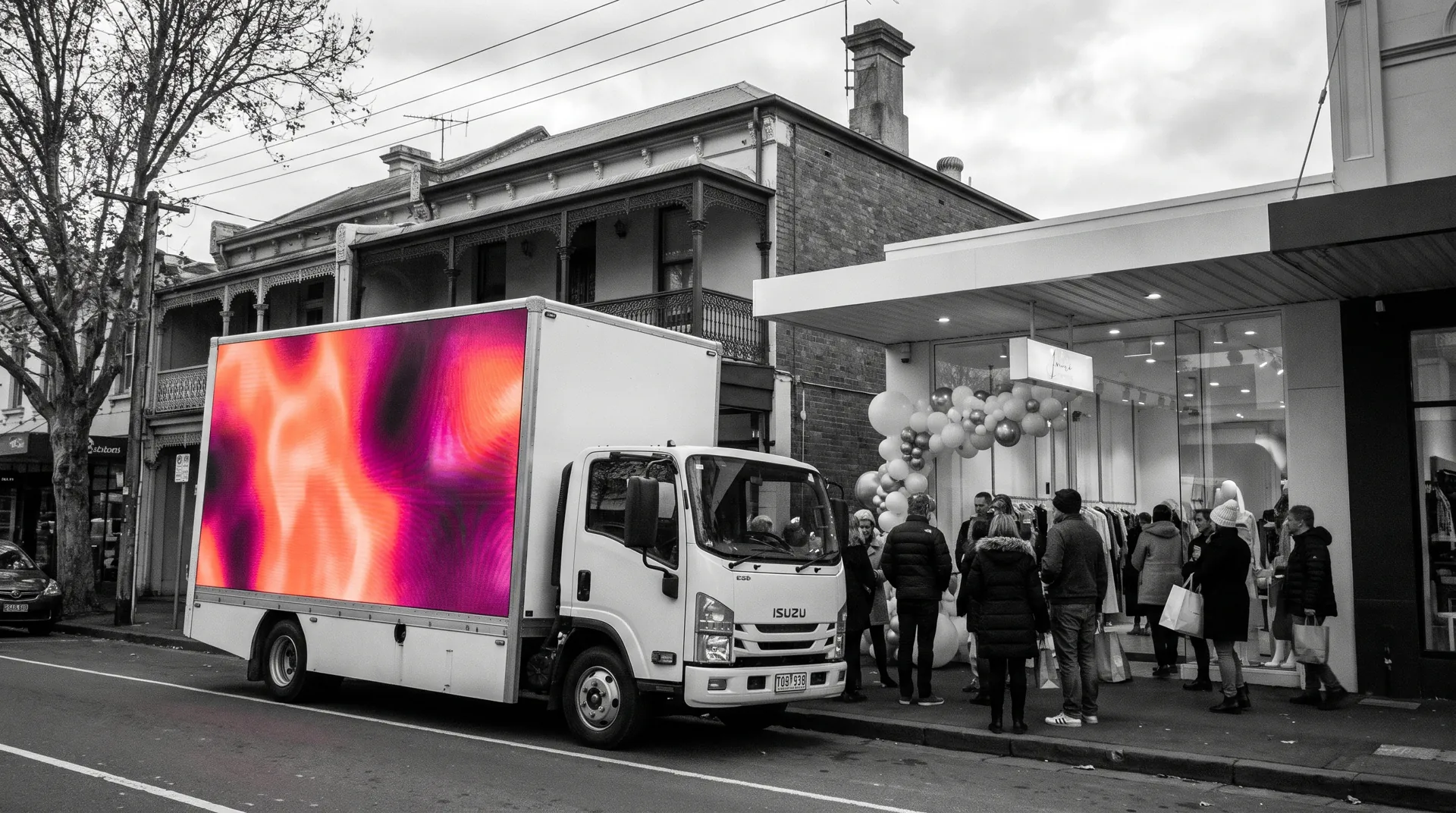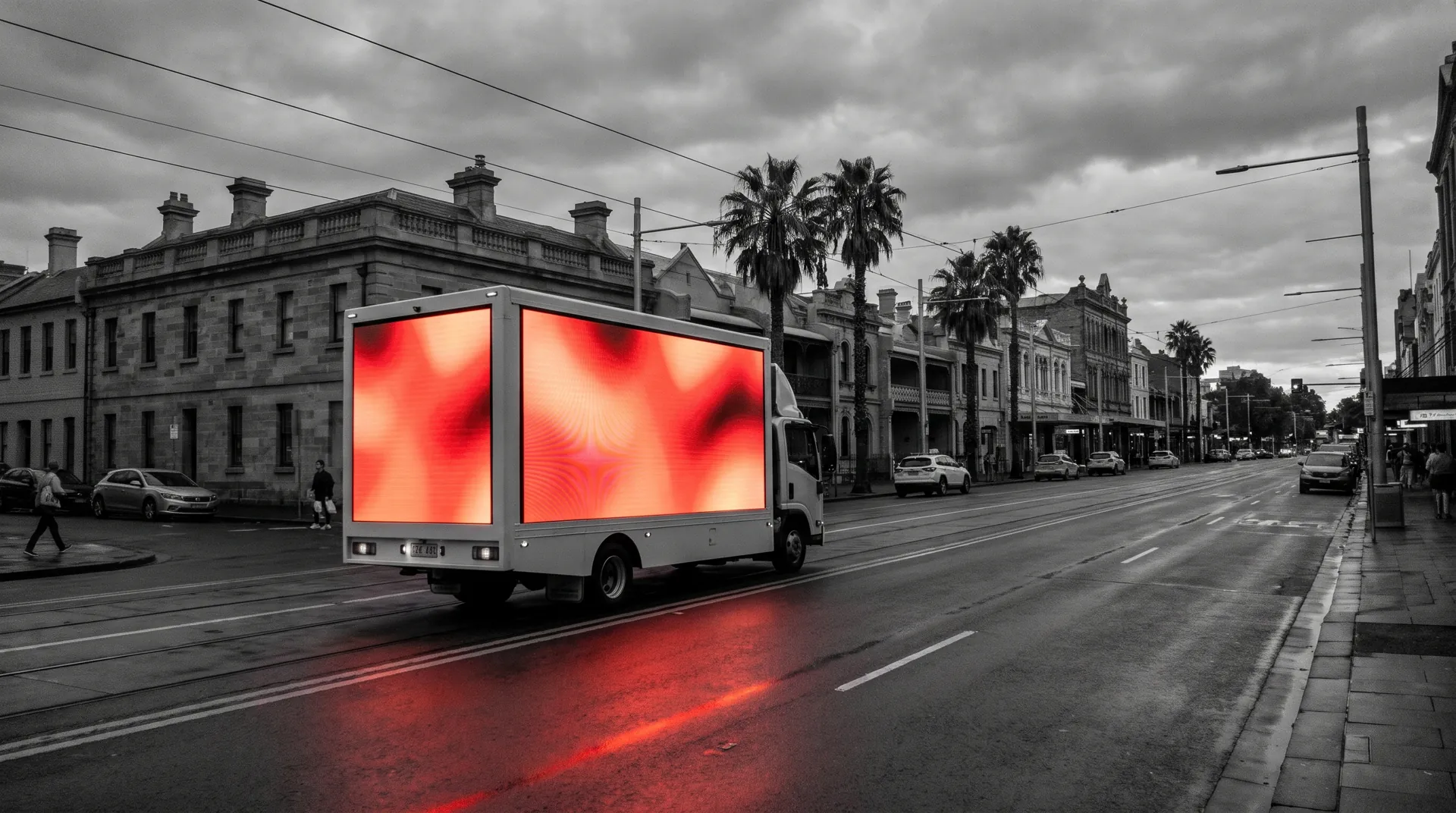
A few years ago, a billboard truck in Adelaide usually meant a printed vinyl sign on the back of a flatbed. Today it is far more likely to be a set of bright LED screens playing video, switching messages by the hour and reporting its position by GPS. The format has changed quickly, and the way brands use it has changed with it.
This article looks at the trends shaping truck advertising and mobile billboards in 2026, what is driving them, and what they mean for Adelaide businesses planning their next campaign. Where we cite industry figures, we link to the original source so you can check them.
The big picture: outdoor advertising keeps growing
Before getting into trucks specifically, it helps to look at the wider out-of-home (OOH) market, because that is the category mobile billboards belong to.
The Outdoor Media Association (OMA) reported that Australian OOH net media revenue reached $1.45 billion in 2025, an 11.43% increase on 2024. Growth continued into 2026: Q1 revenue rose 7.41% to $359 million, Q2 rose 5.58% to $385 million, and the September quarter rose 8.78% to $376 million.
Two things stand out in those numbers. First, outdoor is growing while many traditional channels are not. Second, digital is doing most of the work: digital formats made up around 77% of OOH revenue through 2026, up from about 76% a year earlier.
Mobile LED billboard trucks sit right where those two trends meet. They are outdoor, they are digital, and they are one of the few large-format options a local business can book for a few hours rather than a few months.
Trend 1: Static vinyl is giving way to digital LED
The most visible shift is the move from printed panels to LED screens. Vinyl still has its place for long-term fleet branding (a delivery truck wrapped in your logo for three years is excellent value), but for campaigns, digital has clear advantages:
- Video and motion. Moving images draw the eye far more than a still poster.
- Multiple messages. One booking can rotate several ads or brands.
- No print costs or lead times. Artwork can be changed the same day without reprinting.
- Night visibility. LED screens are fully readable after dark, which adds hours of useful exposure, particularly in winter.
As LED panels have become more affordable and more reliable outdoors, operators have upgraded. The Digifyads fleet, for example, runs three P4 LED screens per truck at 6,500+ nits, which is bright enough for direct summer sun, with weatherproofing rated to IP65.
Trend 2: Dayparting and real-time creative
Because the screens are digital, advertisers have started treating mobile billboards the way they treat online ads: different messages for different times and places.
Dayparting means scheduling creative by time of day. A café chain might show a coffee offer during the morning commute, a lunch deal at noon and a dinner or happy-hour message from 4pm. A retailer might show a "Sale ends Sunday" message on Saturday and switch to "Last day today" on Sunday morning.
Location-based creative takes the same idea further. A truck moving from Glenelg to the CBD can switch from a beach-focused message to an office-worker message as it crosses suburbs.
Real-time updates let brands react on the day: announcing a sold-out item, a last-minute ticket release, a weather-related offer or a live score.
The practical takeaway for Adelaide businesses is simple. When you brief a mobile billboard campaign in 2026, think in terms of a small set of messages matched to times and places, not one poster.
Trend 3: Better measurement and proof of delivery
The biggest historical criticism of outdoor advertising was measurement. You paid for a site and estimated how many people saw it. That is changing on two fronts.
Industry-wide measurement. The Australian OOH industry has moved to MOVE (Measurement of Outdoor Visibility and Exposure) as its single standard for planning, buying and reporting, designed to show not just that outdoor reaches people, but how often, where, when and in which format.
GPS on every truck. For mobile billboards, GPS tracking has become standard. Advertisers can see the exact route, how long the truck stayed in each zone and how fast it was moving. Every Digifyads campaign includes live GPS access and a full route history.
Response tracking. Brands increasingly pair trucks with trackable responses: QR codes shown while parked, short campaign URLs with UTM tags, unique promo codes and dedicated phone numbers. Combined with branded search and foot traffic data, these make it much easier to connect a truck campaign to real outcomes.
Expect this to keep improving. Advertisers who set up tracking before the campaign starts get far more useful answers than those who try to work it out afterwards.
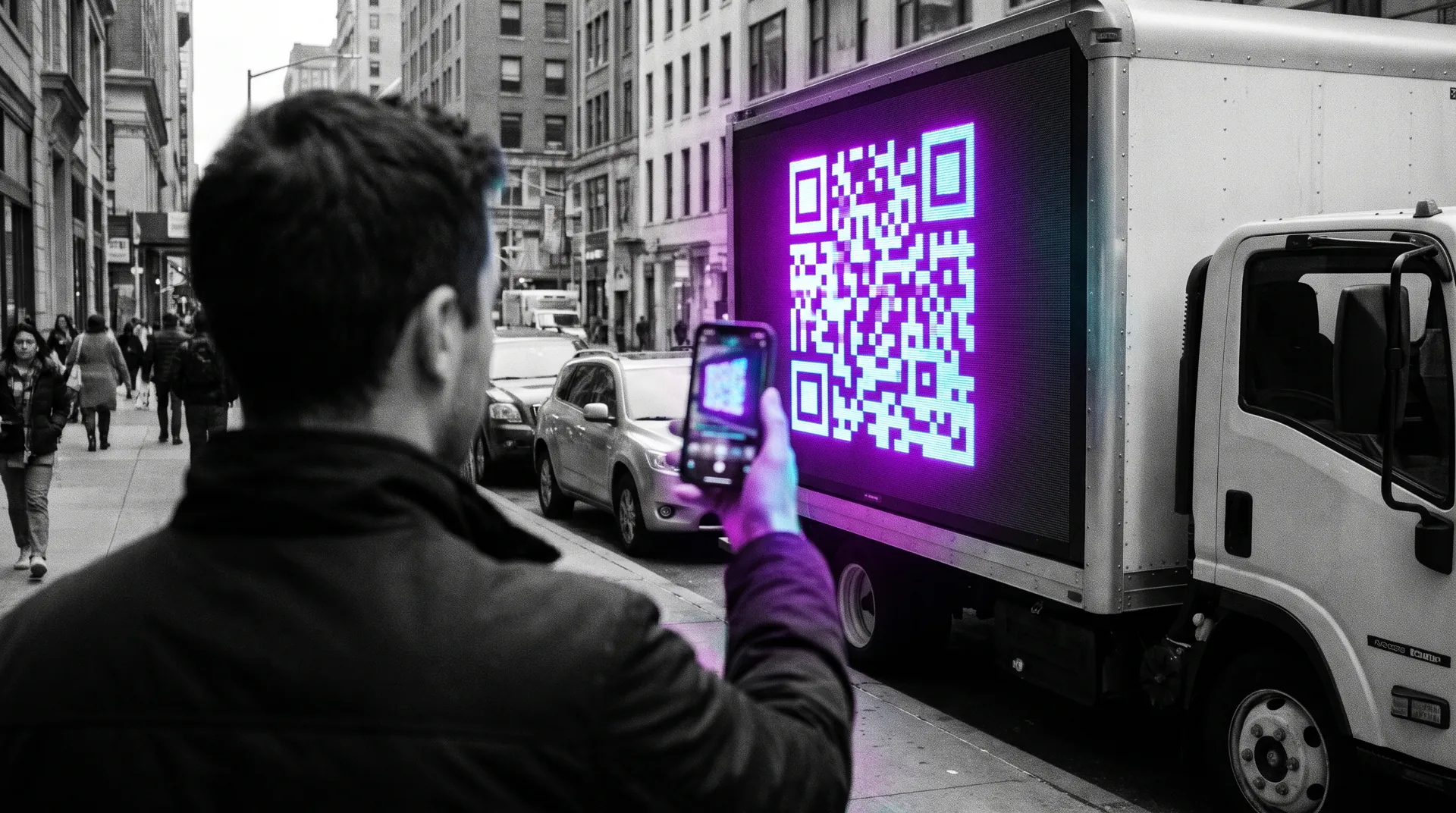
Trend 4: Trucks as part of an omnichannel campaign
Mobile billboards are increasingly planned as one part of a wider campaign rather than a standalone stunt. Common combinations in 2026 include:
- Truck plus social ads. Running Facebook and Instagram ads to the same suburbs in the same week means people see the brand on the street and again on their phones. Each exposure makes the other more effective.
- Truck plus content. Photos and videos of the truck in action, especially with a crowd around it, make strong organic social content and short-form video.
- Truck plus events. Brands bring the truck to their own activations, sampling days and pop-ups as a giant screen and sound system that also gets them there.
- Truck plus search. Visibility on the street drives people to search the brand, so it pays to have search ads and a solid Google Business Profile ready to catch them.
The trucks themselves have become content. A bright screen in an unexpected place is exactly the kind of thing people film and share, which extends reach well beyond the people who saw it in person.
Trend 5: Attention is moving off the phone, at least sometimes
Screen fatigue is real. Australian industry commentary in 2026 has pointed to screen fatigue and new under-16 social media rules as reasons advertisers are looking harder at physical media. Younger audiences in particular are spending less of their time on some of the platforms advertisers have relied on.
Outdoor advertising cannot be skipped, blocked or scrolled past. It reaches people in the real world, in the moments between screens: at the lights, in the queue, walking to the game. For brands trying to reach audiences that are harder to find online, that is increasingly valuable.
Trend 6: Hyperlocal campaigns for small and medium businesses
Large-format outdoor used to be the domain of national brands with national budgets. Flexible mobile billboard pricing has changed that.
With hourly bookings (Digifyads starts at $99 + GST per hour with a three-hour minimum), a local business can run a targeted campaign in a handful of suburbs for less than the cost of many print or radio placements. That has opened the format up to:
- independent retailers and hospitality venues
- real estate agents promoting single properties
- trades and home services building recognition in a service area
- local events, schools, clubs and community groups
We expect this to keep growing. The more local the message ("Now open on King William Road", "Open home Saturday 10am, Henley Beach"), the better the format tends to perform.
Trend 7: Experiential use, with sound and stationary activations
Trucks are no longer just driving billboards. Many campaigns now include planned stationary time where the truck parks near a crowd and becomes a small event in its own right, with sound, video and sometimes brand ambassadors handing out samples.
That works especially well in Adelaide's event-heavy calendar, from Fringe and the Festival to Gather Round, Adelaide Oval fixtures, the Christmas Pageant and summer on the beaches at Glenelg and Henley. Pull up early, play something that catches the ear, and the truck becomes a meeting point rather than a passing vehicle.
Trend 8: Event-driven and competitive targeting
Because a truck can go anywhere, brands are getting more strategic about where. Two approaches are growing:
Event targeting. Placing the truck along the walking route to a stadium, concert or festival, timed to arrivals or departures, reaches tens of thousands of people in a concentrated window.
Competitive targeting. Driving near competitor stores, trade shows or industry events puts your offer in front of customers at the moment they are comparing options. Done tastefully, it is a smart way to win attention from people already in the market.
Trend 9: Sustainability and efficiency
Advertisers are increasingly asking about the environmental side of their media. Digital trucks remove the printing, installation and disposal of vinyl, and modern LED panels use far less power than older display technology. Smart route planning also matters: rather than driving all day, good campaigns mix efficient routes with parked time in high-value locations, which cuts kilometres while often improving results.
Trend 10: Smarter, data-led route planning
Route planning used to rely on a driver's local knowledge and a rough idea of where the traffic was. It is becoming far more deliberate. Operators now combine traffic volumes, event calendars, school and office hours, demographic data by suburb and the GPS history of past campaigns to decide where a truck should be at each hour of the day.
The practical effect is that a modern campaign plan reads more like a media schedule than a driving route. It might look like this:
- 7:00am to 9:00am: inbound arterials from the target suburbs, timed to the commute
- 9:00am to 11:00am: parked near a shopping centre or high street with steady foot traffic
- 12:00pm to 2:00pm: a loop of the CBD lunch precinct
- 3:00pm to 4:00pm: school pick-up zones in two target suburbs
- 4:30pm to 6:30pm: outbound peak on the same arterials
As tools for analysing movement and audience data improve, expect plans to get even more precise, with routes adjusted between campaign days based on what the previous day's GPS and response data showed.
What we are seeing in Adelaide
Adelaide has its own version of these national trends. A few patterns stand out from the campaigns we plan:
Local precincts are getting more attention. Businesses on strips like King William Road, The Parade, Jetty Road and Prospect Road increasingly want to own their own neighbourhood rather than chase city-wide reach.
The event calendar drives demand. Bookings cluster around Fringe and the Festival season, Gather Round, big games at Adelaide Oval and the lead-up to Christmas. Planning early for those windows makes a real difference.
Northern and western growth corridors matter. Fast-growing suburbs in the north and west are home to young families, new home buyers and tradespeople, and they are often under-served by traditional outdoor advertising compared with the CBD and eastern suburbs.
Smaller businesses are giving outdoor a try. Hourly bookings have brought in many businesses that had never used outdoor advertising before, often as a test before committing to longer campaigns.
What these trends mean for your next campaign
If you are planning a mobile billboard campaign in Adelaide in 2026, here is how to make the most of where the format is heading:
- Brief by audience, not by traffic count. Tell your provider who you need to reach, and let them build the route around those people.
- Plan a small set of messages. Match creative to time of day, suburb or event.
- Set up tracking first. Promo codes, campaign URLs, QR codes for stationary moments and a "How did you hear about us?" question.
- Combine channels. Run social ads to the same suburbs and capture content of the truck for your own pages.
- Use stationary time well. Park near crowds, play sound where allowed and give people something to do.
- Repeat. A few days of consistent presence usually beats one isolated burst for awareness.
- Keep it simple. Around seven words, a big logo and a clear action. That rule has not changed.
How Digifyads is building for 2026 and beyond
The Digifyads fleet was built for where truck advertising is going, not where it has been:
- three ultra-bright P4 LED screens per truck (two 3.84m × 1.92m sides and a 1.92m × 1.76m rear)
- automatic brightness for day and night clarity
- IP65 weatherproof screens and a sealed audio system
- live GPS tracking and route history on every campaign
- unlimited creative rotations, including split day and night content on daily bookings
- custom routes across Greater Adelaide, planned around your audience
Explore the fleet, see our pricing or browse the Adelaide areas we cover.
Frequently asked questions
Are mobile billboards still effective in 2026?
Yes. Australian outdoor advertising revenue has grown strongly through 2025 and 2026, with digital formats making up most of it. Mobile LED trucks combine that digital impact with the flexibility to go where the audience is.
What is the difference between a digital billboard truck and a truck wrap?
A wrap is a printed vinyl design fixed to a vehicle for the long term, ideal for fleet branding. A digital billboard truck carries LED screens that play video and rotating ads, and is booked for specific campaigns, routes and times.
Can I change my ad during a campaign?
With digital screens, yes. Creative can be updated between shifts or on the day, and daily bookings can split content between day and night.
How do I measure a truck campaign?
Use GPS route reports alongside promo codes, QR codes, campaign URLs, branded search data, foot traffic and simply asking customers how they heard about you.
Want to put these trends to work? Request a free quote and we will plan a campaign around your audience, or call 0455 665 257.